
我是使用Python进行图像处理的初学者,因此我需要帮助。我正在尝试使用下面发布的代码从图片中删除连接像素的区域。实际上,它有效但并不好。我想要的是从我的图像中删除像素区域,例如下面报告的图片中标记为红色的区域,以获得干净的图片。为连接的像素的检测到的区域的尺寸设置最小和最大限制也很棒。带有标记区域的图片示例 1 具有标记区域的图片示例 2这是我目前的代码:### LOAD MODULES ###import numpy as npimport imutilsimport cv2def is_contour_bad(c): # Decide what I want to find and its features peri=cv2.contourArea(c, True) # Find areas approx=cv2.approxPolyDP(c, 0.3*peri, True) # Set areas approximation return not len(approx)>2 # Threshold to decide if add an area to the mask for its removing (if>2 remove)### DATA PROCESSING ###image=cv2.imread("025.jpg") # Load a picturegray=cv2.cvtColor(image, cv2.COLOR_BGR2GRAY) # Convert to grayscalecv2.imshow("Original image", image) # Plotedged=cv2.Canny(gray, 50, 200, 3) # Edges of areas detectioncnts=cv2.findContours(edged.copy(), cv2.RETR_LIST, cv2.CHAIN_APPROX_SIMPLE) # Find contours: a curve joining all the continuous points (along the boundary), having same color or intensitycnts=imutils.grab_contours(cnts)mask=np.ones(image.shape[:2], dtype="uint8")*255 # Setup the mask with white background# Loop over the detected contoursfor c in cnts: # If the contour satisfies "is_contour_bad", draw it on the mask if is_contour_bad(c): cv2.drawContours(mask, [c], -1, 0, -1) # (source image, list of contours, with -1 all contours in [c] pass, 0 is the intensity, -1 the thickness)image_cleaned=cv2.bitwise_and(image, image, mask=mask) # Remove the contours from the original imagecv2.imshow("Adopted mask", mask) # Plotcv2.imshow("Cleaned image", image_cleaned) # Plotcv2.imwrite("cleaned_025.jpg", image_cleaned) # Write in a file
1 回答

慕少森
TA贡献2019条经验 获得超9个赞
您可以执行以下处理步骤:
使用 将图像阈值设置为二进制图像。
这不是必须的,但在你的情况下,灰色阴影看起来并不重要。cv2.threshold使用闭合形态学操作,用于闭合二进制图像中的小间隙。
与参数一起使用,用于获取白色聚类周围的等值线(周长)。
cv2.findContourscv2.RETR_EXTERNAL修改“不良轮廓”的逻辑,仅当面积较大时才返回 true(假设您只想清理大三个轮廓)。
以下是更新的代码:
### LOAD MODULES ###
import numpy as np
import imutils
import cv2
def is_contour_bad(c): # Decide what I want to find and its features
peri = cv2.contourArea(c) # Find areas
return peri > 50 # Large area is considered "bad"
### DATA PROCESSING ###
image = cv2.imread("025.jpg") # Load a picture
gray = cv2.cvtColor(image, cv2.COLOR_BGR2GRAY) # Convert to grayscale
# Convert to binary image (all values above 20 are converted to 1 and below to 0)
ret, thresh_gray = cv2.threshold(gray, 20, 255, cv2.THRESH_BINARY)
# Use "close" morphological operation to close the gaps between contours
# https://stackoverflow.com/questions/18339988/implementing-imcloseim-se-in-opencv
thresh_gray = cv2.morphologyEx(thresh_gray, cv2.MORPH_CLOSE, cv2.getStructuringElement(cv2.MORPH_ELLIPSE, (5,5)));
#Find contours on thresh_gray, use cv2.RETR_EXTERNAL to get external perimeter
_, cnts, _ = cv2.findContours(thresh_gray, cv2.RETR_EXTERNAL, cv2.CHAIN_APPROX_NONE) # Find contours: a curve joining all the continuous points (along the boundary), having same color or intensity
image_cleaned = gray
# Loop over the detected contours
for c in cnts:
# If the contour satisfies "is_contour_bad", draw it on the mask
if is_contour_bad(c):
# Draw black contour on gray image, instead of using a mask
cv2.drawContours(image_cleaned, [c], -1, 0, -1)
#cv2.imshow("Adopted mask", mask) # Plot
cv2.imshow("Cleaned image", image_cleaned) # Plot
cv2.imwrite("cleaned_025.jpg", image_cleaned) # Write in a file
cv2.waitKey(0)
cv2.destroyAllWindows()
结果:
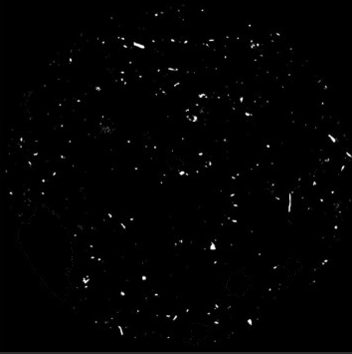
标记用于测试的轮廓:
for c in cnts:
if is_contour_bad(c):
# Draw green line for marking the contour
cv2.drawContours(image, [c], 0, (0, 255, 0), 1)
结果:
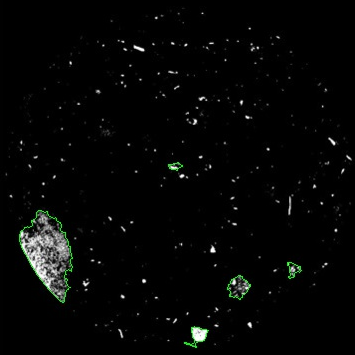
仍有工作要做...
更新
两个迭代方法:
第一次迭代 - 删除大轮廓。
第二次迭代 - 删除小而明亮的轮廓。
代码如下:
import numpy as np
import imutils
import cv2
def is_contour_bad(c, thrs): # Decide what I want to find and its features
peri = cv2.contourArea(c) # Find areas
return peri > thrs # Large area is considered "bad"
image = cv2.imread("025.jpg") # Load a picture
gray = cv2.cvtColor(image, cv2.COLOR_BGR2GRAY) # Convert to grayscale
# First iteration - remove the large contour
###########################################################################
# Convert to binary image (all values above 20 are converted to 1 and below to 0)
ret, thresh_gray = cv2.threshold(gray, 20, 255, cv2.THRESH_BINARY)
# Use "close" morphological operation to close the gaps between contours
# https://stackoverflow.com/questions/18339988/implementing-imcloseim-se-in-opencv
thresh_gray = cv2.morphologyEx(thresh_gray, cv2.MORPH_CLOSE, cv2.getStructuringElement(cv2.MORPH_ELLIPSE, (5,5)));
#Find contours on thresh_gray, use cv2.RETR_EXTERNAL to get external perimeter
_, cnts, _ = cv2.findContours(thresh_gray, cv2.RETR_EXTERNAL, cv2.CHAIN_APPROX_NONE) # Find contours: a curve joining all the continuous points (along the boundary), having same color or intensity
image_cleaned = gray
# Loop over the detected contours
for c in cnts:
# If the contour satisfies "is_contour_bad", draw it on the mask
if is_contour_bad(c, 1000):
# Draw black contour on gray image, instead of using a mask
cv2.drawContours(image_cleaned, [c], -1, 0, -1)
###########################################################################
# Second iteration - remove small but bright contours
###########################################################################
# In the second iteration, use high threshold
ret, thresh_gray = cv2.threshold(image_cleaned, 150, 255, cv2.THRESH_BINARY)
# Use "dilate" with small radius
thresh_gray = cv2.morphologyEx(thresh_gray, cv2.MORPH_DILATE, cv2.getStructuringElement(cv2.MORPH_ELLIPSE, (2,2)));
#Find contours on thresh_gray, use cv2.RETR_EXTERNAL to get external perimeter
_, cnts, _ = cv2.findContours(thresh_gray, cv2.RETR_EXTERNAL, cv2.CHAIN_APPROX_NONE) # Find contours: a curve joining all the continuous points (along the boundary), having same color or intensity
# Loop over the detected contours
for c in cnts:
# If the contour satisfies "is_contour_bad", draw it on the mask
# Remove contour if area is above 20 pixels
if is_contour_bad(c, 20):
# Draw black contour on gray image, instead of using a mask
cv2.drawContours(image_cleaned, [c], -1, 0, -1)
###########################################################################
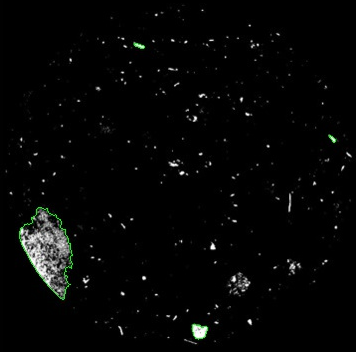
标记轮廓:
添加回答
举报
0/150
提交
取消